
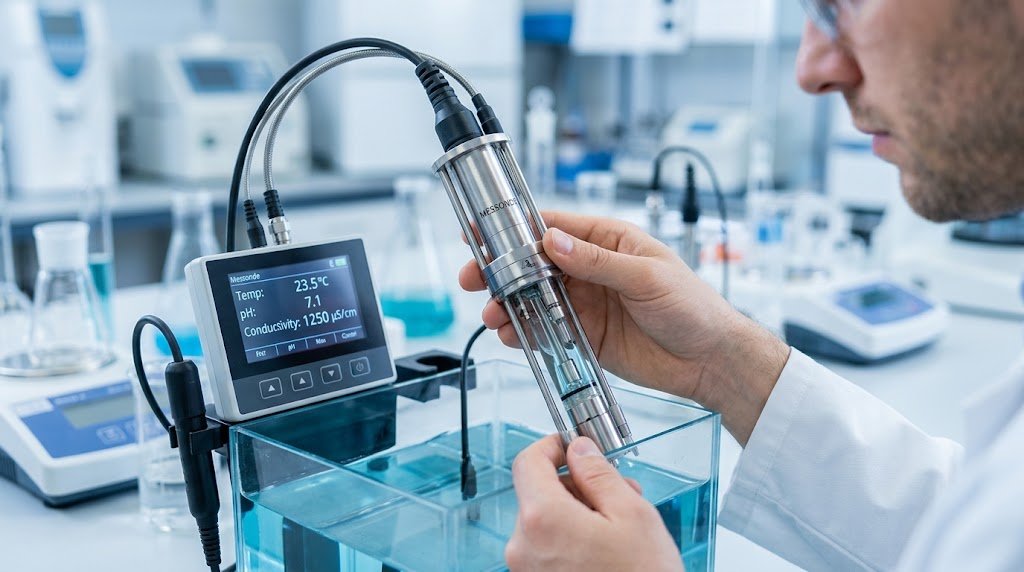
If you searched for Messonde after seeing the word in a manual, product listing, technical document, or online article, the first thing to know is that the spelling is ambiguous. In technical contexts, Messonde usually points to the established German term Messsonde, which is used for a measuring probe or measuring device. The German Federal Agency for Nature Conservation’s marine thesaurus, for example, gives “Measuring Probe/Device” as an English alternative label for Messsonde/-Gerät.
At the same time, the exact spelling Messonde is also used online as a website name and as a coined idea associated with curiosity and exploration. That type of usage can exist within a particular website or community without making the word a standardized engineering, linguistic, or philosophical term.
The most useful way to understand the word is therefore to check context first. If you are looking at sensors, instrumentation, laboratories, industrial equipment, or measurement systems, the technical meaning is usually the relevant one.
Messonde at a Glance
| Item | Practical meaning |
|---|---|
| Search term | Messonde |
| Established German technical form | Messsonde |
| Common English equivalent | Measuring probe/device |
| Main function | Detect or measure a physical or chemical property |
| Typical settings | Industry, laboratories, process control, environmental measurement and equipment testing |
| Separate online use | A coined name or symbolic concept on some websites |
| Not automatically the same as | Radiosonde, complete measuring instrument or every generic sensor |
What Does Messonde Mean?
In an engineering or scientific setting, Messonde is best interpreted as a reference to a measuring probe. A measuring probe is the part of a measurement system that comes into contact with, enters, faces, or otherwise senses the thing being measured.
That “thing” might be temperature, pressure, oxygen concentration, electrical conductivity, liquid level, humidity, thickness, distance, or another measurable property. The probe responds to the target condition and passes a signal to electronics that can display, record, transmit, or use the result.
The most appropriate English wording depends on the actual equipment. “Measuring probe” is a particularly useful translation, but individual products may be described more specifically according to what they measure.
Messonde vs. Messsonde: What Is the Correct Spelling?
For technical German, Messsonde is the form supported by technical terminology resources. Messonde, with one fewer “s,” is better treated as a search spelling, altered spelling, name, or context-dependent online term unless the original source clearly defines it otherwise.
The difference matters when you are trying to find a manual, replacement part, datasheet, or manufacturer documentation. Searching only for Messonde may return articles discussing the keyword itself. Searching for Messsonde plus the equipment name, measurement type, model number, or manufacturer is more likely to uncover relevant technical material.
A useful rule is simple:
- Use Messsonde when referring to the German measurement term.
- Treat Messonde as ambiguous until the surrounding context clarifies it.
- Use an English equipment term such as measuring probe or the device’s specific sensor name when communicating with an English-speaking technical audience.
Why Do Search Results Give Different Definitions?
Current search results split into two broad groups.
One group treats Messonde as a technical term connected with measuring probes and sensors. This interpretation has a clear connection to the established German word Messsonde.
The other group presents Messonde as a modern philosophy, productivity framework, creative mindset, or symbol of exploration. Such interpretations appear primarily in newer web content rather than established scientific or linguistic terminology.
The important distinction is evidence. A website is free to define a coined term for its own editorial or branding purposes, but that does not automatically make the definition standardized in English, engineering, psychology, productivity, or another established field.
That is why a careful explanation should not claim that Messonde has an ancient origin, formal philosophical tradition, or recognized productivity methodology unless reliable evidence supports those statements.
How a Measuring Probe Works
A measuring probe is usually only one part of a complete measurement chain. The exact technology changes by application, but the basic flow is similar:
Measured property → sensing element → signal → processing → result
First, the sensing element reacts to a physical or chemical condition. A temperature element may change electrical resistance as temperature changes. A pressure sensor responds to a pressure-related physical effect. A conductivity probe interacts electrically with a liquid. An oxygen probe may use an electrochemical, optical, or another purpose-built sensing method.
Next, the probe or connected electronics converts that response into a usable signal. A meter, controller, data logger, computer, or automation system then interprets the signal and presents or acts on the result.
This is why the word Messonde should not be treated as the name of one specific device. It describes a broad measurement role when interpreted through Messsonde, while the actual sensing principle depends on what needs to be measured.
Common Types of Measuring Probes
Temperature probes
Temperature probes are used anywhere a system needs direct information about heat: manufacturing equipment, heating and cooling systems, laboratories, food processes, engines, storage areas, and test rigs.
Depending on the application, the sensing element may use a thermocouple, resistance temperature detector, thermistor, semiconductor sensor, or another technology. The correct choice depends on factors such as range, response time, required accuracy, environment, and connection method.
Pressure probes and sensors
Pressure-measurement devices are used in pipes, tanks, hydraulic systems, pneumatic equipment, engines, laboratories, and process systems.
Some measure pressure at a specific point, while others are components within more complex differential-pressure or flow-measurement arrangements.
Gas and oxygen probes
Gas probes can be designed to measure oxygen or other gases in air, exhaust streams, process gases, or liquids.
Automotive oxygen sensors are a familiar example of sensing equipment that detects oxygen in exhaust gas, although a specific product would normally be referred to by its proper technical name rather than simply as a Messonde.
Conductivity and liquid-analysis probes
Conductivity probes are common in water treatment, laboratories, chemical processes, environmental monitoring, and other systems where dissolved ions affect electrical conductivity.
Other liquid-analysis probes may measure pH, dissolved oxygen, oxidation-reduction potential, temperature, or related parameters. Each measurement requires its own sensing principle and appropriate operating conditions.
Level, distance, and material-measurement probes
A probe may also be used to detect liquid level, distance, displacement, coating thickness, surface properties, vibration, or other material characteristics.
The generic word alone does not tell you which measurement is being performed. The specification sheet is therefore more useful than the broad label.
Is a Messonde the Same as a Sensor?
Not always. Sensor is a broad term for a device or element that detects a physical or chemical condition. A probe is often the physical assembly positioned where the measurement is taken, and it may contain the sensor itself.
For example, a temperature probe can consist of a protective sheath, sensing element, insulation, cable, and connector. The sensor is the responsive element within the assembly; the probe provides the physical form that allows that element to be positioned in the process.
In everyday product terminology, however, manufacturers and users sometimes overlap terms such as sensor, probe, transducer, detector, and measuring head.
The safest approach is to focus on function, output, measurement range, construction, and compatibility rather than assuming that two product labels always represent identical hardware.
Is Messonde the Same as a Radiosonde?
No. A radiosonde is a specific meteorological instrument package carried aloft by a weather balloon. The U.S. National Weather Service explains that radiosonde sensors transmit measurements including atmospheric pressure, temperature and relative humidity as the package rises through the atmosphere.
That is a much narrower meaning than a general measuring probe. The similar sonde ending can create confusion, but radiosonde is its own established technical term.
If your context involves weather balloons or upper-air observations, search for radiosonde, not Messonde.
Why Accuracy, Calibration, and Installation Matter
A probe is useful only if the measurement can be trusted. A high-quality sensor can still produce misleading results when it is installed in the wrong location, operated outside its rated range, contaminated, damaged, or paired with unsuitable electronics.
Calibration is one part of maintaining confidence in a measurement system. NIST defines calibration in terms of establishing, under specified conditions, the relationship between indications from a measuring instrument or system and corresponding known measurement values.
In practice, users should pay attention to:
- measurement range;
- specified accuracy and uncertainty;
- response time;
- operating temperature and pressure;
- chemical compatibility;
- cable and connector requirements;
- output type or communication protocol;
- mounting position;
- cleaning requirements;
- calibration procedure and interval.
There is no universal maintenance schedule for every Messonde-type probe. The appropriate interval depends on the sensor technology, application, operating environment, manufacturer instructions, and applicable quality requirements.
How to Identify What “Messonde” Means in Your Context
If you encounter Messonde in a document or search result, use this short process.
1. Look at the surrounding subject
Words such as temperature, pressure, oxygen, probe, sensor, calibration, tank, process, laboratory, or measurement strongly suggest the technical interpretation.
2. Search the spelling “Messsonde”
Try the established German form together with the product or measurement. Searching for a temperature Messsonde, oxygen Messsonde, equipment model, or manufacturer can be considerably more useful than searching the ambiguous spelling alone.
3. Identify the measurand
The measurand is the quantity intended to be measured. Knowing whether the system measures temperature, pressure, conductivity, oxygen, level, or another property immediately narrows the possible device type.
4. Check the manufacturer’s documentation
A manufacturer datasheet should tell you the operating range, accuracy, materials, output, connector, calibration requirements, and intended use.
Those specifications are much more useful when identifying real equipment than a generic description of the word.
5. Separate brand or editorial use from technical use
If the page discusses creativity, exploration, lifestyle, or personal development rather than measurement equipment, Messonde may simply be a coined name or site-specific concept.
How to Choose the Right Measuring Probe
When the search term leads you to an actual sensor or probe purchase, start with the measurement requirement rather than the generic label.
Ask:
- What exactly needs to be measured?
- What are the minimum and maximum expected values?
- What accuracy is required?
- How quickly must the probe respond?
- Will it contact water, food, fuel, chemicals, exhaust, dust, or corrosive material?
- Does it require continuous installation or occasional handheld use?
- What output does the receiving instrument accept?
- Is traceable calibration required?
- What physical size and mounting method fit the equipment?
These questions are more useful than searching for a generic Messonde because they connect the device to the actual engineering requirement.
Common Misunderstandings to Avoid
The biggest mistake is assuming every page using the word refers to the same thing. Current online usage does not support that conclusion.
Another mistake is treating Messonde as the official name of a single technology. Measuring probes cover numerous sensing principles, designs, and industries.
It is also risky to assume that a coined online definition has formal authority. A website may use Messonde as a symbolic term for exploration or another idea, but readers should distinguish such editorial usage from established German measurement vocabulary.
Finally, do not confuse a probe with the complete measuring instrument. The probe may provide only the sensing assembly, while signal conditioning, display, control, storage, and communication occur elsewhere in the system.
Final Takeaway
Messonde is best treated as an ambiguous search term. In technical contexts, the most defensible interpretation is the established German word Messsonde, referring to a measuring probe or measurement device. In nontechnical contexts, the exact spelling may instead be a coined name, website identity, or editorial concept rather than standardized terminology.
If you found the word while researching equipment, search the correct German spelling and then narrow the results by the property being measured, equipment model, and manufacturer. That will usually produce more useful information than relying on the keyword alone.
5. Frequently Asked Questions
What does Messonde mean in English?
In a technical context, Messonde usually points to the German word Messsonde, which can be understood in English as a measuring probe or measuring device. The exact terminology can vary with the equipment.
Is Messonde the same as Messsonde?
Not exactly. Messsonde is the established German technical form. The shorter spelling is ambiguous and appears in searches and online names, so context should determine what the writer intended.
Is Messonde an English dictionary word?
The exact spelling does not appear to have a widely standardized technical meaning in the authoritative terminology sources reviewed. Being used online or as a website name is different from having one generally accepted English definition.
Is it a sensor?
It can refer to a sensor or measuring probe when the context is technical, but sensor is a broader term. A probe is often the physical assembly positioned at the measurement point and may contain the sensing element.
Is it another word for radiosonde?
No. A radiosonde is specifically a balloon-borne meteorological instrument that measures atmospheric conditions and sends data to a receiving station. The terms should not be used interchangeably.
How can I find the correct probe for my equipment?
Search using the quantity being measured, equipment model, operating range, required accuracy, output type, connector, and manufacturer. When working with German documentation, include Messsonde in the search.
Does the term also mean exploration or personal growth?
Some websites use it that way as a coined or symbolic concept. That interpretation should be treated as site-specific or editorial unless broader authoritative sources establish it as a standardized meaning.

1 Comment
Pingback: Marinegensets.com