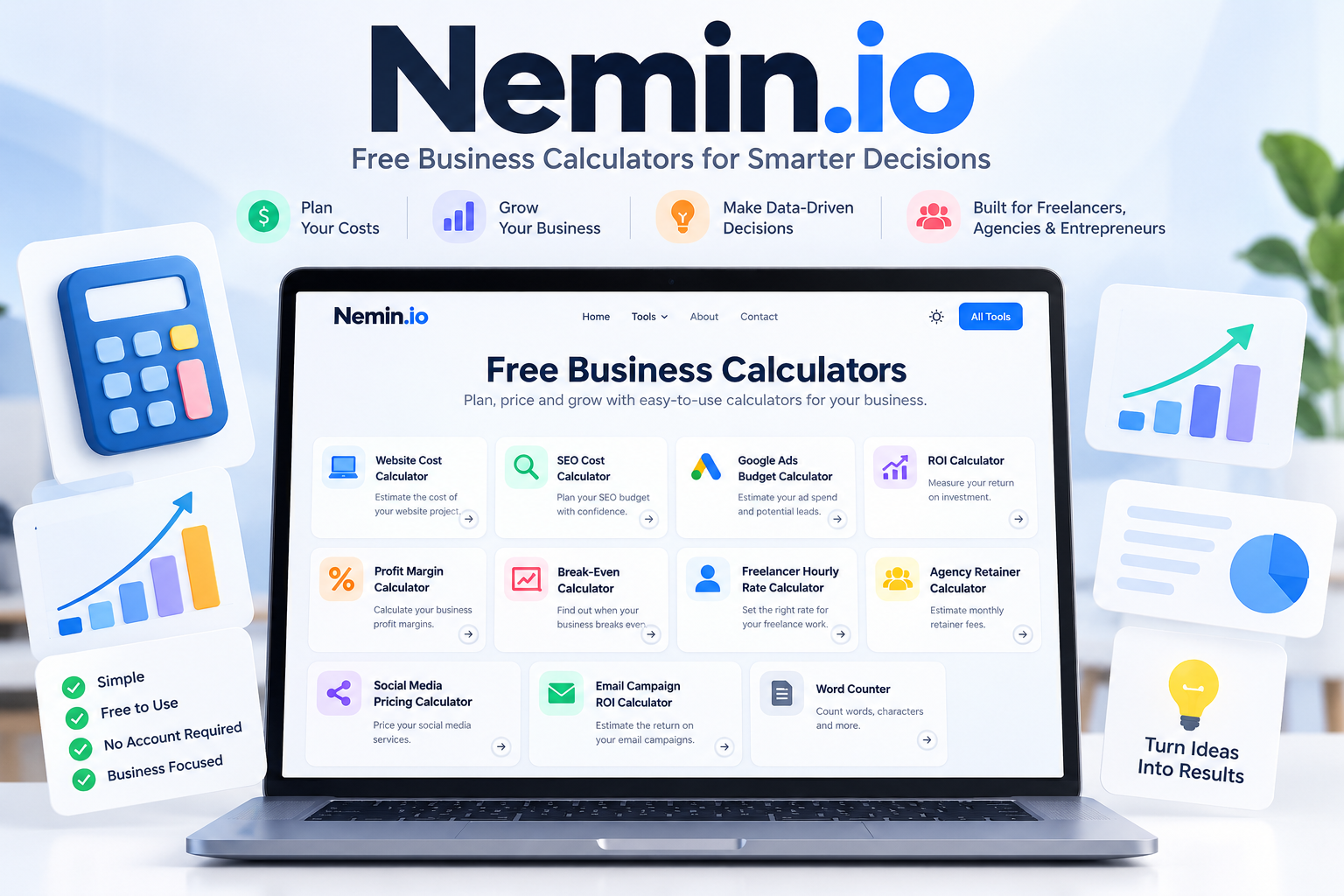
Nemin.io is a website offering free online calculators for common business and marketing decisions. Its tools cover website budgets, SEO spending, ad campaigns, freelance rates, profitability, and more. You can access the calculators in a web browser without signing up, according to the site.
For someone preparing a client proposal or checking whether a product price covers expenses, that simplicity is useful. But a calculated estimate is not the same as a supplier quote, verified financial statement, or prediction of future sales. This guide explains what Nemin.io provides, which tools fit different tasks, and how to assess the numbers before acting on them.
What Is Nemin.io, and Who Is It For?
Nemin.io describes itself as a collection of business-focused calculators rather than a full accounting or analytics platform. Its primary audience is freelancers, agencies, entrepreneurs, consultants, marketers, and small-business owners. The site emphasizes estimates for businesses operating in the United States.
Most tools follow a straightforward workflow: select a calculator, enter assumptions, calculate an estimate, and compare scenarios. The platform’s appeal is its narrow scope. You do not need to build a spreadsheet model just to explore a potential hourly rate or advertising budget.
The trade-off with Nemin.io is depth. A short form cannot automatically know your supplier contracts, tax circumstances, customer acquisition costs, or market conditions. Those details still need to come from your own records and research.
All 11 Nemin.io Tools at a Glance
The official tools directory lists the following calculators and content utility:
| Tool | Main question it helps answer |
|---|---|
| Website Cost Calculator | What budget might a website project require? |
| SEO Cost Calculator | What monthly budget should I explore for search optimization? |
| Google Ads Budget Calculator | What ad spend might support a target number of leads? |
| ROI Calculator | How does revenue compare with the investment made? |
| Profit Margin Calculator | What percentage of revenue remains after the costs entered? |
| Break-Even Calculator | How many units must I sell to cover costs? |
| Freelancer Hourly Rate Calculator | What hourly rate might support my income and expenses? |
| Agency Retainer Calculator | What monthly fee could cover client work and a profit target? |
| Social Media Pricing Calculator | How might workload affect a monthly management fee? |
| Email Campaign ROI Calculator | What revenue and return might email campaign assumptions produce? |
| Word Counter | How long is a piece of text in words, characters, and other measures? |
These tools are related, but they answer different questions. A planned SEO spend is not an SEO performance forecast. Likewise, a profit margin calculation does not reveal whether customers will accept the selling price.
Which Calculator Should You Use?
For a website or SEO proposal
The Website Cost Calculator asks about page count, design quality, platform setup, content-writing needs, maintenance months, and SEO setup. It can help turn a vague project request into a rough budgeting conversation.
However, a five-page brochure site and a five-page site with custom integrations may differ dramatically in cost. Treat the result as an early range. Request a written scope covering design revisions, hosting, security, integrations, accessibility, and ongoing support before agreeing to a price.
The SEO Cost Calculator accepts inputs including target keywords, campaign type, website size, monthly blog volume, target locations, and growth goals. Use it to explore how campaign scope changes an estimated monthly budget. Do not treat the result as a guaranteed ranking outcome or as a substitute for a provider’s itemized proposal.
For advertising and email marketing
The Google Ads Budget Calculator includes desired monthly leads, landing-page conversion rate, expected cost per click (CPC), and a management fee. These inputs matter because a lead target can imply very different spending levels depending on click cost and conversion performance.
Google explains that average CPC is calculated from the actual cost of clicks, while its average daily budget is not necessarily the amount spent every single day. A planning tool therefore cannot promise a fixed number of clicks or leads.
The Email Campaign ROI Calculator asks for list size, open rate, click-through rate, conversion rate, average order value, and campaign cost. Use consistent definitions for each percentage. In particular, check whether a click-through rate is measured against delivered emails or opens; mixing definitions can distort a forecast. Also distinguish projected purchases from purchases actually attributed to a campaign.
For freelance and agency pricing
The Freelancer Hourly Rate Calculator considers target annual income, annual business expenses, billable hours per week, working weeks, and a tax buffer. Its most valuable input may be billable time: a freelancer who works 40 hours each week rarely invoices clients for every one of those hours.
The Agency Retainer Calculator uses monthly hours, an hourly rate, software and tool costs, and a desired profit margin. The Social Media Pricing Calculator takes account of platforms, weekly posts, monthly short videos, managed ad spend, and reporting level.
These figures can help establish an initial price. Before quoting, account separately for onboarding, meetings, strategy, revisions, subcontractors, platform fees, and unusually tight deadlines. Specify whether advertising spend is included in or separate from your management fee.
For profitability and business planning
The Profit Margin Calculator takes revenue and total cost, while the ROI Calculator compares revenue generated with total cost. Both depend heavily on what the user includes under “cost.” Omitting labor, delivery, refunds, software subscriptions, or fees can make performance appear stronger than it really is.
The Break-Even Calculator asks for fixed costs, selling price per unit, and variable cost per unit. It is especially useful when testing whether a price leaves enough contribution per sale to cover recurring expenses. The Word Counter serves a different purpose: it measures text length for drafting and editing rather than evaluating financial performance.
Two Examples That Make the Numbers Easier to Judge
Consider a hypothetical business with $1,500 in monthly fixed costs. It sells a product for $50, with $20 of variable cost per sale. Each sale contributes $30 toward fixed expenses. Dividing $1,500 by $30 gives a break-even point of 50 units. That is a mathematical illustration, not a reported Nemin.io result. If variable costs rise to $25, the break-even requirement increases to 60 units.
This is the same general fixed-cost approach described by the US Small Business Administration’s break-even resource. It also shows why optimistic cost inputs are risky.
Now imagine a hypothetical advertising campaign aiming for 40 leads, with an assumed 4% landing-page conversion rate and $2 average CPC. The simplified model implies 1,000 clicks and $2,000 in click costs. Add a $400 management fee and the planning total becomes $2,400, before other expenses. Actual performance may differ because conversion rates and click prices change.
How to Get More Useful Results from Nemin.io
A reasonable way to use Nemin.io is to treat every output as one scenario, not a final answer.
- Start with the decision you need to make: pricing, budgeting, or measuring a result.
- Collect real inputs from invoices, platform reports, work logs, or written supplier estimates where possible.
- Confirm that all figures use the same time period and currency.
- Run a cautious scenario, a central scenario, and an optimistic scenario by changing uncertain inputs.
- Check major calculations against a spreadsheet or an authoritative formula before committing money.
- Record which costs were excluded and what assumptions would invalidate the estimate.
This approach makes the calculators more useful in discussions with clients or colleagues. Instead of sharing an unexplained number, you can explain what changes it.
Is Nemin.io Free, and What About Privacy?
The Nemin.io website states that its calculators are free and do not require account creation. Its pages also provide contact, privacy, and terms information. That makes it convenient for someone who needs a quick calculation without subscribing to a software product.
Free access should not be confused with the absence of data collection. The site’s Privacy Policy, effective October 6, 2026, says it may collect device and usage information and use cookies or similar technologies. It also discusses possible analytics and advertising partners. These disclosures do not establish exactly what data is processed during every calculator interaction.
For ordinary budgeting, enter estimates rather than confidential customer information when possible. Avoid including personal identifiers or commercially sensitive details that a calculator does not need. Review the current policy before submitting information, particularly if using the site on behalf of clients.
How Accurate Are Nemin.io Calculations?
Accuracy has two parts: whether the calculation is mathematically correct and whether its assumptions reflect reality.
The official Terms and Conditions say that calculator outputs are informational estimates, not guaranteed financial, legal, or professional business advice. A clean result screen therefore should not be mistaken for independently validated methodology.
Straightforward quantities such as margin or break-even units can be checked with familiar formulas. Budget estimates are more subjective because they may depend on market rates, competition, and the scope of work. An estimate can be internally consistent and still differ from an actual quote.
It is also important to separate gross revenue from profit. A campaign that generates $5,000 in sales has not necessarily earned $5,000 in profit. Product costs, salaries, fulfillment, software, and other expenses may materially change the return.
For a major loan, contract, advertising commitment, or tax decision, verify the inputs and seek qualified advice appropriate to that decision.
Who Will Benefit Most?
Nemin.io is most relevant when the next task is a quick estimate: a freelancer setting a baseline rate, an agency evaluating retainer scope, a startup comparing marketing budgets, or a seller checking a break-even target.
Nemin.io is less suited to work requiring detailed bookkeeping, audited results, automatic campaign data imports, or a custom financial forecast with many linked assumptions. A spreadsheet or specialized software gives more control when inputs and formulas need ongoing review.
Its strongest role is helping users frame an initial question. A useful calculator can reveal what information is missing, even when it cannot deliver a final decision.
Final Assessment
Nemin.io offers an accessible starting point for business and marketing calculations without account registration. Its 11 listed tools cover several common decisions, from freelance pricing to ad budgets and profitability. The practical next step is to choose the calculator matching your question, enter defensible assumptions, and validate the output before using it in a quote, budget, or investment decision.
5. Frequently Asked Questions
1. Is Nemin.io completely free to use?
Yes. The website currently describes its business and marketing calculators as free to use without creating an account. Users should check the site for any future changes to its access terms.
2. How many tools does Nemin.io offer?
The official directory currently lists 11 tools covering website pricing, SEO budgets, Google Ads, ROI, profit margins, break-even analysis, freelance rates, agency retainers, social media pricing, email campaign ROI, and text measurement.
3. Can I trust the calculator results?
You can use the results as preliminary estimates, but their accuracy has not been independently established for every scenario. Check the input assumptions and verify important calculations before making financial commitments.
4. Can I use Nemin.io outside the United States?
The website is accessible online and emphasizes US-oriented business estimates. Users in other countries can apply the underlying planning concepts, but should adjust currency, local pricing, taxes, employment costs, and market conditions.
5. Does Nemin.io require a software download?
The listed tools are accessible through the website in a browser. You do not need to install desktop software to use the available online calculators.
6. Does Nemin.io collect personal information?
Its Privacy Policy describes potential collection of voluntarily submitted information, technical data, usage information, and cookies. Not needing an account does not mean browsing is entirely anonymous. Review the policy before entering sensitive information.
7. Can these calculators replace professional accounting or marketing software?
No. They are suitable for individual estimates and planning exercises, but not substitutes for full accounting records, campaign attribution systems, or professional advice. Use specialized tools when your business requires detailed reporting, historical records, and validated forecasts.