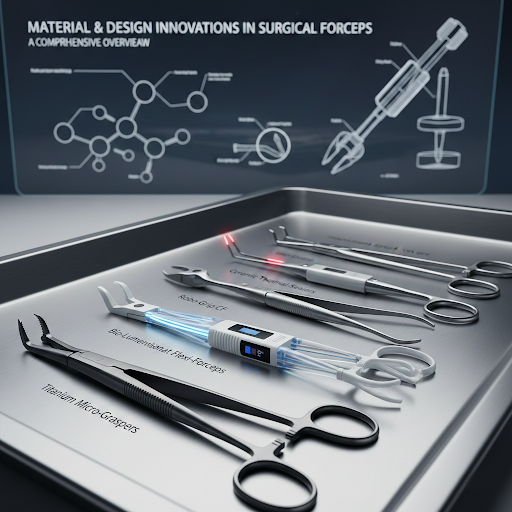
The highlight: Peak Surgical is a popular product known for its innovation, precision, and highest quality.
Forceps used in surgery are among the essential tools of modern medicine. They can be used for grasping tissues or clamping sutures, clamping blood vessels, and manipulating fragile structures. Forceps are indispensable in any operating room. Over the last ten years, technological advances in biomedical engineering, materials science, and ergonomics have drastically changed how instruments are constructed and how surgeons use them. These advances aren’t just cosmetic improvements; they directly enhance surgical outcomes and patient safety, support long-term instrument use, and improve patient comfort.
As one of the most popular global sellers of surgical forceps, Peak Surgical has been a key player in developing and promoting these breakthroughs, providing medical professionals with forceps that exceed international standards. In this extensive 2000-word piece, we examine the astonishing development of materials, manufacturing techniques, and technological advancements that will shape the future Generation of forceps for surgery.
- Evolution of Surgical Forceps: From Basic Steel Tools to High-Performance Instruments
In the past, surgical forceps were basic mechanical instruments made from carbon steel. While functional, traditional forceps were not without their flaws, including corrosion issues, inefficient sterilization cycles, and poor grip precision.
Over time, demand for surgical procedures increased: surgeons required tools that could withstand extreme temperatures, withstand frequent sterilization, withstand delicate handling, and maintain a high level of precision. This has led to accelerated advancement of materials — from carbon steel to stainless steel, then to titanium, and finally to hybrid, composite, or polymer-integrated designs.
Today’s forceps are designed by combining mechanical engineering, metallurgy, and ergonomics, providing superior performance in high-stress surgical environments. Top manufacturers such as Peak Surgical have been major contributors to these advances, introducing durable instruments with unbeatable accuracy.
- Material Innovations Transforming Surgical Forceps
2.1. High-Grade Stainless Steel: The Industry Standard
The most commonly utilized substance for forceps used in surgery is due to its
- Corrosion resistance
- High Tensile Strength
- Compatible with sterilization
- Cost-effectiveness
In most cases, 300400 series stainless steels are used. These steels offer:
- Hardness of gripping
- Edge retention
- Non-reactivity with human tissue
- Structural stability is excellent for the OR
Peak Surgical uses the highest-quality medical-grade stainless steel to ensure tools remain sturdy and reliable after hundreds of cycles.
2.2. Titanium Forceps: Lightweight Strength and Precision
Titanium is an important milestone in surgical instrument materials thanks to its outstanding biocompatible and mechanical properties. Titanium forceps can offer:
- 40 percent lighter than steel
- Superior corrosion resistance
- Reduced the fatigue of surgeons
- Magnetic surface that is non-magnetic (ideal to use in an MRI environment)
- Highly biocompatible
Titanium instruments are extremely advantageous in:
- Neurosurgery
- Ophthalmic procedures
- Microsurgeries
- Operation of the heart
Manufacturers such as Peak Surgical use titanium to develop premium lines of forceps designed for specific disciplines.
2.3. Tungsten Carbide Reinforcement for Enhanced Grip
The most significant material innovation is the tungsten carbide (TC) inserts. It is among the toughest industrial materials, and when integrated into the edges or gripping surfaces of forceps, it offers distinct advantages.
- Extraordinary grip force
- Reducing slippage when handling needles or tissue
- Superior wear resistance
- Extended life of the instrument
Inserts from TC are particularly frequent in:
- Needle holders
- Tissue forceps
- Hemostatic forceps
Peak Surgical combines advanced TC designs and microtextures that give surgeons greater control and stability during complex procedures.
2.4. Polymer-Integrated Forceps: Lightweight and Non-Conductive
The addition of high-performance medical polymers to forceps is not new and offers distinct advantages:
- Lightweight construction
- Heat-resistant and non-conductive
- Disposable and semi-disposable options
- Color codes for easy identification of instruments
Polymers that are used for this include:
- Polyetheretherketone (PEEK)
- Polypropylene
- Medical-grade nylon
Polymer forceps are great for:
- Electrosurgery
- Diagnostic procedures
- Single-use sterilized environments
Peak Surgical has expanded its polymer-based line to meet increasing demand for affordable, high-performance disposable forceps.
2.5. Hybrid Materials: The Future of Forceps Engineering
Hybrid forceps mix metals and polymers, including titanium and carbide, to make custom-designed instruments that perform. The advantages include:
- Optimized weight distribution
- Enhanced tactile feedback
- Coatings with ergonomic grip
- A special tip strength, with lightweight handles
The hybrid designs are especially popular in robotic and microsurgery, where even the slightest deviation in tactile precision can alter the results.
- Design Innovations Improving Surgical Efficiency
While improvements in material technology set the stage, new design concepts make forceps more intuitive, comfortable, ergonomic, and efficient. Modern surgeons require instruments that minimize fatigue, increase control, and adjust to a variety of surgical conditions.
Top manufacturers like Peak Surgical stay ahead of the curve by designing forceps that meet real-world surgical requirements.
3.1. Advanced Ergonomic Handles for Reduced Surgeon Fatigue
Ergonomics plays an important role in reducing strain and fatigue during lengthy surgical procedures. New handle designs focus on:
- Anti-slip grip patterns
- Forms condensed that are shaped to fit the natural hand curves
- Pressure-distribution zones to prevent fatigue
- Surfaces coated with silicone or texturing
Ergonomically designed forceps help surgeons maintain hand steadiness and reduce the risk of tremor during microsurgery.
3.2. Precision-Engineered Tips for Superior Control
The design of the tip is among the most crucial aspects of forceps innovation. Modern enhancements include:
Technology for micro-serration
- Allows firmer tissue grip
- Prevents accidental slips
- Reduces tissue trauma
Ultra-fine tips
- Utilized in neurosurgical and ophthalmic procedures
- Enable delicate tissue handling
Round, traumatic suggestions
- Reduce the risk of soft tissue damage.
Curved, angled, or bayonet designs
- Increase access to deep or narrow surgical sites.
Peak Surgical uses laser-cut, precise patterning of the tip to ensure consistent performance.
3.3. Improved Locking Mechanisms
Hemostatic forceps rely heavily on effective locking systems. Modern advancements include:
- Multi-position ratchet locks
- Smooth-click locking systems
- Stress-reduction mechanisms to facilitate release
These advances help prevent accidental unlocking and also reduce the surgeon’s effort.
3.4. Non-Slip Coatings and Surface Treatments
The field of surface engineering is now a major area of innovation in instrumentation. The latest methods include:
- A diamond micro-coating for improved friction
- Satin Matte finishes to minimize glare when using surgical lighting
- Electropolishing to resist corrosion
- The grips are microtextured for more control of the tactile
Forceps treated with surface treatment maintain their high performance even in blood-saturated or moist environments.
3.5. Modular and Multi-Functional Forceps
To cut down on obstructions within the OR, engineers are now producing multi-functional forceps that can be customized, like:
- Exchangeable-tip forceps
- Forceps with suction channels
- Combination grasping-and-cutting instruments
These designs boost efficiency and decrease tray expenses.
- Manufacturing Innovations: Precision Through Technology
Modern forceps are made with the most modern manufacturing techniques, which include:
4.1. Laser Cutting and Micro-Machining
Laser machining allows:
- Serrations that are ultra-fine
- Micro-level detailing
- Patterns that are consistent in replication
- Geometries with fine tips are not achievable in traditional forging
This technology is crucial for neurosurgical and ophthalmic instruments.
4.2. CNC Machining for Consistency and Accuracy
Computer Numerical Control (CNC) machineries ensure:
- Uniformity across batches of production
- Micron-level precision
- Perfect alignment, smooth edges, and smooth edges
Peak Surgical uses state-of-the-art CNC equipment to ensure the highest quality.
4.3. Robotic Polishing and Finishing
Robotic systems can now help in:
- Polishing of mirrors with mirror-finish
- Surface smoothing
- Edge refinement
This decreases the chance of human error and increases durability.
4.4. Additive Manufacturing (3D Printing)
3D Printing is becoming a trend in prototype development and specialty forceps manufacturing. The advantages include:
- Tailored designs for unique surgeries
- Speedier customisation
- Lightweight lattice structures
- Reduction of material waste
Although the technology is still in development, 3D-printed surgical instruments are poised to transform surgery in significant ways.
- Emerging Trends Driving the Future of Surgical Forceps
A new generation of surgical forceps will focus on integration, intelligence, and long-term sustainability.
5.1. Smart Forceps that have Sensors
Future models could include:
- Sensors for heat
- Pressure-sensitive grip indicators
- Real-time feedback from the tissue
- Wireless connectivity
These advanced tools could transform surgical precision.
5.2. Sustainable and Eco-Friendly Disposable Forceps
Hospitals are increasingly deciding to:
- Recyclable materials
- Biodegradable polymers
- Reduced-waste packaging
Peak Surgical is already exploring ways to make sustainable production lines.
5.3. Forceps for Robotic-Assisted Surgery
As robotic surgery becomes more advanced, forceps have to evolve along with it:
- Miniaturized tips
- Accurate articulation with enhanced joints
- High-flexibility materials
- Improvements in feedback through haptic
Manufacturers are developing designs compatible with Da Vinci and other surgical robots.
- Why Peak Surgical Leads the Market in High-Performance Forceps
Peak Surgical stands as a leading supplier of surgical forceps that are renowned worldwide due to:
High-end materials (stainless steel, titanium, and polymer hybrids)
Modern CNC manufacturing with lasers and high-end production
Custom-designed tip geometries and ergonomic designs
Tungsten carbide enhancements to increase endurance
The product range is extensive and covers all surgical specialties.
Global conformity standards
Hospitals and surgeons rely upon Peak Surgical for instruments that offer unrivaled performance, security, and long-term durability.
Conclusion
Surgical forceps have evolved far beyond simple metal tools. They are now designed with precision using the most advanced materials, modern manufacturing techniques, and micro design. These advancements significantly improve surgical accuracy, reduce fatigue, and improve patient outcomes. As the field expands its use of new technology — from intelligent sensors to advanced polymers —the forks that will come in the next decade will be more effective, flexible, and customized.
Peak Surgical, as a leading supplier of surgical forceps, remains at the forefront of these advances, providing instruments that combine the latest technology, quality, and superior clinical performance. Through constant research and a commitment to the highest quality, Peak Surgical is shaping the future of surgical instrumentation, one forceps at a time.