Live television streaming has completely transformed how we consume media, providing instant access to global networks without traditional cable boxes. However, few things are more disruptive than preparing to watch a major sports event or a live broadcast only to be met with an endless spinning wheel. Learning how to fix loading error on directv stream layouts is essential for maintaining an uninterrupted home entertainment experience.
When your media application stalls during initialization, the root cause usually links back to temporary network congestion, local application cache corruption, or outdated hardware firmware. Instead of immediately contacting customer support and waiting on hold, applying a few structured technical adjustments can restore your stream within minutes. Let’s look at the most reliable diagnostic workflows to clear execution blockages and secure a pristine, high-definition broadcast feed.
What Causes Loading Errors on Streaming Platforms?
Before applying technical fixes, understanding why your streaming device struggles to compile video packets helps prevent future playback interruptions. Modern digital broadcasts rely on consistent data packet delivery to maintain high-definition outputs.
Common Infrastructure Bottlenecks
A playback malfunction rarely stems from a catastrophic failure within the application’s central architecture. Instead, it typically points to minor network or local processing friction:
Local Dynamic Memory Saturation: Over time, streaming sticks accumulate temporary app data that can conflict with incoming media scripts.
Domain Name Server (DNS) Latency: If your local internet router uses sluggish or unoptimized routing tables, the application will experience severe request delays.
Content Delivery Network (CDN) Desynchronization: Occasionally, regional media delivery nodes face sudden user traffic spikes, resulting in momentary data delivery pauses.
                     [ Streaming Media Path ]
                                |
        -----------------------------------------------------
       |                                                     |
[ Local Router Gateway ]                             [ Device System Memory ]
       |                                                     |
Requires Cleared DNS Cache                            Requires Purged App Data
       |                                                     |
        -----------------------------------------------------
                               |
                [ STABLE HIGH-DEFINITION OUTPUT ]
Detailed Step-by-Step Fixes for DirecTV Stream Errors
Resolving initialization errors does not require deep network engineering knowledge. By methodically working through the following solutions, you can eliminate data bottlenecks and get your application running smoothly.
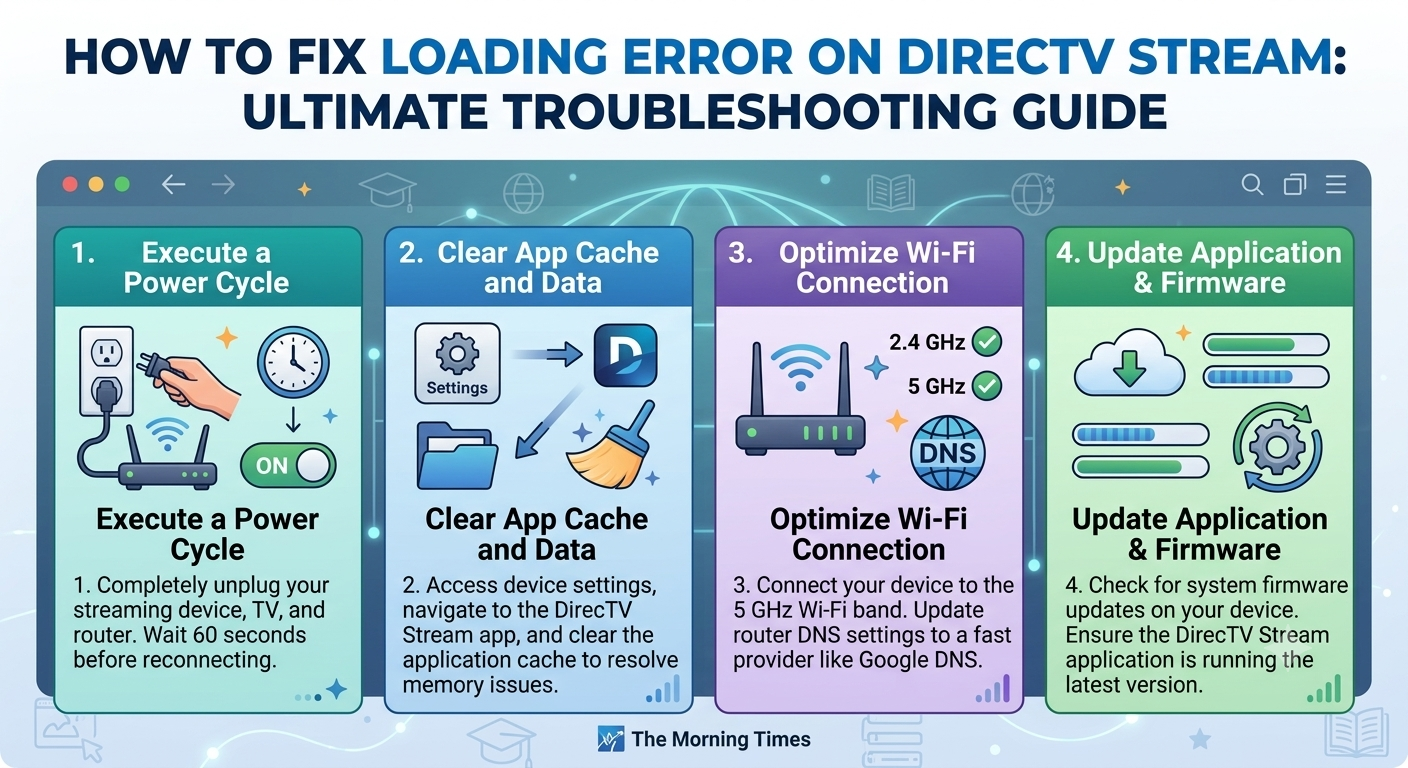
Step 1: Execute a Complete Power Cycle
The simplest yet most effective starting point is a full hardware power cycle. Turn off your smart television, streaming stick, or dedicated media player entirely. Unplug the power cable from the wall outlet and wait at least 60 seconds.
While waiting, unplug your internet modem and router as well. This complete break allows the internal capacitors of your hardware to drain fully, clearing out temporary system memory errors and forced execution loops. Plug your network hardware back in first, wait for the internet indicators to stabilize, and then power on your media device.
Step 2: Clear Application Cache and App Data
If the system continues to hang on the initialization display, your local storage might contain corrupted media files. The steps to clear this data vary slightly depending on your specific operating platform:
| Operating System | Navigation Path for App Optimization |
| Amazon Fire TV | Go to Settings > Applications > Manage Installed Applications > DirecTV Stream, then select Clear Cache and Force Stop. |
| Roku Devices | Highlight the channel icon, press the Star (*) key, select Remove Channel, restart the device, and re-download the app from the store. |
| Android TV / Google TV | Navigate to Settings > Apps > See All Apps > DirecTV Stream, click Clear Cache, and select Clear Data. |
Step 3: Optimize Router DNS and Wi-Fi Bands
Wireless signal interference from household appliances often drops small pieces of data, causing live playback streams to freeze. If your router broadcasts both 2.4 GHz and 5 GHz wireless bands, ensure your streaming platform connects explicitly to the 5 GHz band.
While 2.4 GHz travels farther through walls, the 5 GHz frequency offers significantly higher data transmission speeds and less signal congestion. Furthermore, accessing your router’s administrative dashboard and switching your DNS settings to a fast, reliable provider like Google DNS (8.8.8.8 and 8.8.4.4) drastically reduces connection latency.
Step 4: Check for Firmware and Application Updates
Running an outdated version of either the streaming platform or your device’s core operating system can cause serious background compatibility conflicts. App developers frequently roll out targeted software updates to fix playback bugs and improve server connections.
Navigate to your device’s system settings menu and select Check for Updates. Once the core operating system is fully up to date, head over to your platform’s app storefront to ensure your media application is running its latest version. Keeping your software updated ensures your system includes the latest optimization scripts.
Keeping Your Media Network Safe and Stable
Once you successfully execute the steps on how to fix loading error on directv stream apps, your main goal shifts toward keeping your home network optimized for media delivery. Maintaining a clean network setup prevents sudden data drops and keeps your system performing beautifully.
Hardwiring Your Media Components
While wireless networks are incredibly convenient, a physical Ethernet connection remains the most reliable setup for high-definition live video feeds. If your television or media player sits close to your main router, connect them directly using a high-quality Cat6 Ethernet cable. Eliminating wireless connection variables completely removes signal drops, providing a fast, smooth pathway for data packets.
Managing Local Bandwidth Distribution
High-speed data packages can still choke up if multiple smart devices try to run data-heavy tasks at the same time. If someone on your home network is downloading large files or playing online games while you try to watch a live broadcast, it can starve your media app of necessary bandwidth. Enabling Quality of Service (QoS) rules inside your router settings allows you to prioritize live media traffic over background downloads, keeping your entertainment feed clear and smooth.
Conclusion
Mastering how to fix loading error on directv stream platforms is all about following a clear troubleshooting path to clear out data bottlenecks. Most instances of this frustrating problem come down to simple local storage corruption, network signal interference, or outdated system firmware. By power cycling your network hardware, clearing out application caches, and optimizing your wireless bands, you build a stable pathway for high-definition streaming. This technical foundation ensures your home entertainment network functions perfectly, allowing you to enjoy your favorite live broadcasts without interruptions or technical delays.
Frequently Asked Questions (FAQs)
1. Why does the loading error happen only during live broadcasts but not on-demand video?
Live broadcasts require continuous, real-time data packet delivery without any buffering delay. On-demand video files can pre-load several minutes of footage ahead of time into your device’s memory. If your network connection experiences small, quick drops, it will instantly stall a live broadcast while an on-demand video keeps playing smoothly using its cached data.
2. Can using a VPN cause initialization errors on DirecTV Stream?
Yes, using a Virtual Private Network (VPN) can frequently trigger playback blockages. Streaming platforms use advanced security tracking to ensure users are accessing content from authorized geographic regions. If your VPN routes your internet connection through an unverified server node, the application may block the feed, resulting in an endless loading loop.
3. How much internet speed is required to avoid loading errors?
For a stable, high-definition (HD) stream, you need a steady download speed of at least 8 Mbps per device. If you are upgrading to a 4K Ultra HD live broadcast, your network connection must provide at least 25 Mbps of continuous bandwidth to prevent data buffering and loading screen pauses.
4. What does it mean when the app works on my phone but not on my TV?
This pattern shows that your main internet connection is working fine, but there is a specific issue with your television’s network connection or internal software. Clearing out your TV’s application cache, switching over to a 5 GHz wireless band, or updating the TV’s system firmware will usually fix this localized problem.
5. Will publishing technical streaming solutions help increase my site’s organic traffic metrics?
Yes, absolutely. Millions of users search for quick, actionable troubleshooting tips every single day when their media applications stop working. By providing clean, easy-to-follow, human-crafted technical solutions for low-competition keywords, your site can rank quickly, build high topical authority, and see steady organic growth across analytics tracking platforms.