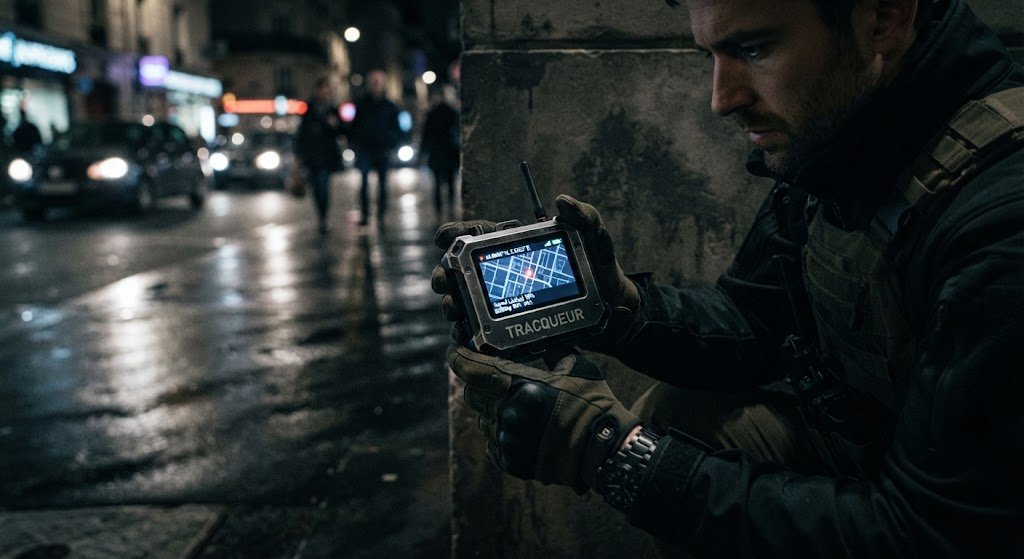
Tracqueur is an online spelling of a tracker: a device or system that follows the location, movement, or activity of something and reports it back to you. It might be a tag on your keys, a GPS unit in a van, or a fitness band. The word has a French flavour — the French word is traqueur, spelled without a c — but “tracqueur” itself is not a dictionary entry in French or in English. It is a broad online term, not one specific product. This guide explains what it is, how the types work, and how to choose one.
Related reads: our guide to Zavalio Com, our review of Crypto30x Com, and our look at Simplifydiggs Com show how we check unfamiliar technology terms.
Table of Contents
- Meaning
- How It Works
- GPS vs Bluetooth
- Where It Is Used
- Features to Look For
- Privacy
- Conclusion
- Frequently Asked Questions
Quick Facts
| Detail | What we found |
|---|---|
| Term | Tracqueur |
| Meaning | Tracker — a device or system that monitors location, movement, or activity |
| French origin | Traqueur, from the verb traquer, “to track or pursue” (hunting term from 1798) |
| Standard English term | Tracker |
| Types | GPS, Bluetooth, Wi-Fi, cellular, RFID, ultra-wideband, wearable |
| GPS satellites | At least 24 operational satellites in the US GPS constellation |
| Real company | Traqueur SA, founded in France in 1997, builds vehicle-recovery systems |
| One specific product? | No — a broad term, not a single device or standard |
What Does Tracqueur Mean?
The simplest interpretation of tracqueur is tracker: something used to locate, follow, monitor, or record the activity of a target. Depending on the context, it may describe a physical tracking device, a software-based monitoring system, or a website analytics tool that records what visitors do.
The established French spelling is traqueur, from traquer, meaning to track or pursue — a hunting term dating from 1798. The spelling with a c is an online blend of the English word “tracker” and that French ending. So the honest answer is that a tracqueur is a word people use online for a tracker, not a dictionary entry in French or in English. A real company shares the name: Traqueur SA, founded in France in 1997, builds vehicle-recovery systems that find stolen vehicles. That is a company name, not the generic term.
How Does a Tracqueur Actually Work?
A useful way to understand a modern tracqueur is to stop thinking about it as one device and instead think about it as a tracking stack — several layers working together. First comes the positioning or sensing layer: the system has to detect something. For location, that may come from GPS, Bluetooth, Wi-Fi positioning, cellular networks, RFID, or ultra-wideband (UWB). GPS.gov notes that GPS satellites transmit positioning and timing signals that receivers use to calculate their position.
Second is the connectivity layer. Knowing a position inside the device is only part of the job. A real-time tracqueur may transmit information using a cellular network, Bluetooth, Wi-Fi, or a low-power network. GPS itself generally tells a receiver where it is; a separate communications channel is usually needed if somebody elsewhere needs to see that location remotely. That distinction is frequently overlooked. A data platform then turns raw coordinates into maps, alerts, and history.
GPS Tracqueur vs Bluetooth Tracker
People frequently compare these technologies as though one is simply better. That is the wrong question. A GPS-oriented tracqueur is typically appropriate when you need to determine where something is across a large geographic area. GPS satellites provide worldwide positioning capability, and GPS.gov notes that the United States maintains at least 24 operational satellites, with additional satellites commonly operating in the constellation. GPS-based systems are useful for vehicles, pets, boats, bikes, and valuable equipment.
However, satellite positioning and remote communication should not be confused. A GPS receiver may determine its coordinates without cellular service, but transmitting those coordinates to your phone from miles away normally requires another communication mechanism — and usually a subscription. Bluetooth tracking, by contrast, is particularly effective for proximity and indoor-location applications. Bluetooth technology can determine the presence, approximate distance, and — in advanced implementations — direction of another Bluetooth device. Advanced Bluetooth direction-finding can be centimetre-accurate in suitable conditions, but an ordinary consumer tag is not.
For keys and luggage, a compact Bluetooth tag usually beats a power-hungry GPS unit. The right question is what happens when the item leaves your range.
Where Is Tracqueur Technology Used?
Vehicle security and fleet management is the largest use. Fleet systems combine location history with route efficiency, driver behaviour, trip duration, geofencing, utilisation, maintenance information, and operational alerts. A delivery business cares more about route efficiency than about watching every vehicle.
What Features Should You Look For?
Start with the job, not the specifications. Decide what you are tracking, over what distance, and how often you need an update. Then check battery life, because a tracker that needs charging every day will spend half its life on a charger. Check whether a subscription is required — many GPS trackers need a monthly mobile plan, while Bluetooth tags usually do not. Look for geofencing (alerts when something enters or leaves an area), a clear app, location history, and a sensible size and weight for the item it will be attached to. Water resistance matters for pets and outdoor equipment.
Tracqueur Privacy: What Users Should Not Ignore
Tracking technology creates real privacy risks, and the law takes them seriously. Tracking your own property is generally allowed; tracking a person without their consent is not. In France, for example, tracking a person without consent can carry up to one year in prison and a 45,000 euro fine, and other countries have similar rules. Always check the law where you live before using a tracker on a person, including an employee or a family member.
Also consider the data. A tracker that stores months of location history creates a detailed record of where someone has been. If that data is stored in the cloud, ask who can see it, how it is protected, and how long it is kept. Avoid trackers from unknown brands with no privacy policy.
Conclusion
A tracqueur is a tracker — a device or system that monitors the location, movement, or activity of something — and the word comes from the French traqueur, meaning someone or something that tracks or pursues. GPS, Bluetooth, Wi-Fi, and cellular trackers all do the same basic job in different ways, and the right one depends on what you are tracking and how far away it can go. Choose the tracking system, not the buzzword, and remember that the Global Positioning System only tells a device where it is — getting that answer back to you is a separate job, and usually the one you pay for.
Frequently Asked Questions
What is a tracqueur used for?
A tracqueur is used to monitor the location, movement, or activity of vehicles, pets, luggage, equipment, people, or digital activity, depending on the type.
Is a tracqueur the same as a GPS tracker?
No. GPS is only one type of tracking. The wider term also covers Bluetooth, Wi-Fi, cellular, RFID, and wearable tracking.
Can a tracker work without a SIM card?
A Bluetooth tag can work without a SIM card for nearby finding, but a GPS tracker that reports its location from miles away normally needs a cellular connection, which usually means a SIM and a subscription.
Does a tracqueur work indoors?
GPS works poorly indoors. Bluetooth, Wi-Fi positioning, and ultra-wideband are better suited to indoor tracking.
Is using tracking technology legal?
Tracking your own property is generally allowed, but tracking a person without consent is illegal in many countries and can carry serious penalties. Check local law first.
What is the difference between tracqueur and traqueur?
Traqueur is the established French word for tracker. Tracqueur is an online spelling variant that blends the English word “tracker” with the French ending.