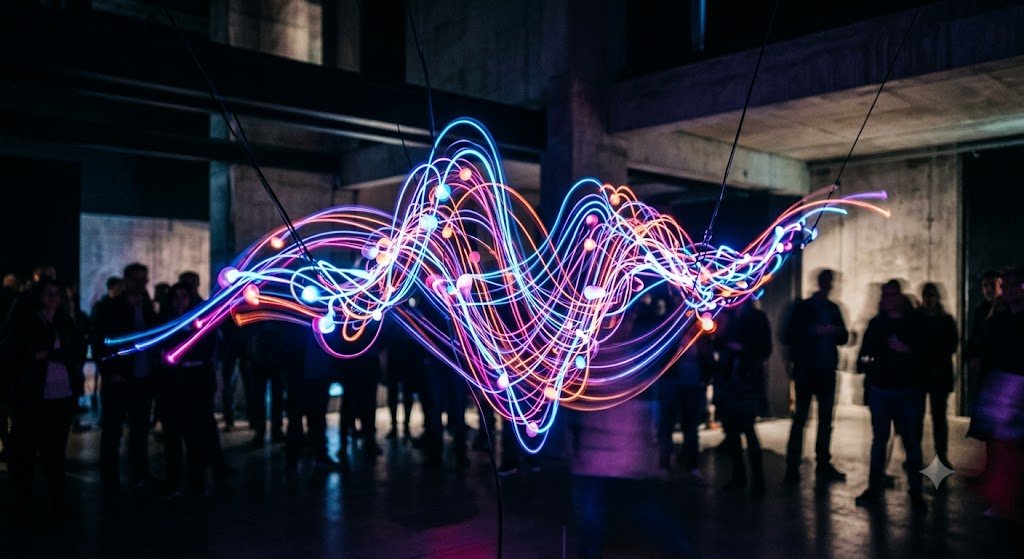
Pulsamento is increasingly used online to describe a recurring pulse, beat, vibration or cycle that gives movement a recognizable structure. The word sounds technical, but its safest interpretation is broader and more practical: it is a label for repetition organized through time, whether that repetition appears in music, breathing, machinery, light, data or visual design.
That definition needs an important qualification. The word is not a widely standardized English scientific or musical term, so responsible writers should not treat it as a newly discovered force, a medical diagnosis or a formal theory. Established English dictionaries define nearby concepts such as pulse, pulsation and pulsate as regular beating, rhythmic movement or recurring bursts of energy, which provides the clearest linguistic foundation for understanding the term.
What Does Pulsamento Mean?
In simple language, Pulsamento means a repeated event that creates a sense of pulse or flow. A ticking clock, a flashing indicator, footsteps on a staircase and a drum pattern can all illustrate the idea, although each belongs to a different field and should be described with its own technical vocabulary when precision matters.
A useful working definition is:
Pulsamento is the perceived or measurable recurrence of movement, sound, energy or change over time.
This definition separates the concept from vague claims about “universal energy.” It also makes room for both regular patterns, such as a metronome, and variable patterns, such as breathing that speeds up during exercise.
The Four Building Blocks
Most examples can be understood through four elements:
- Repetition: The event occurs more than once.
- Interval: Each occurrence is separated by a period of time.
- Intensity: One pulse may be stronger or weaker than another.
- Variation: Timing, force, duration or shape may change across the sequence.
These elements give readers a better analytical framework than simply calling every repeated movement “rhythm.” They also connect the term with established measurements such as frequency, beats per minute, amplitude, pulse width and cycle duration.
Is Pulsamento a Real Word or an Internet Coinage?
The honest answer is that its status depends on context. The concept it points toward is real, but the exact word is not broadly standardized in English reference works or mainstream technical vocabularies.
Some online articles claim that it is the normal Italian word for pulsation. That is misleading. Treccani, a major Italian reference source, lists pulsazione for physiological pulsation and for a periodic quantity in physics, while tracing it to Latin pulsatio and pulsare.
This distinction matters for E-E-A-T. A trustworthy explanation should distinguish between:
- A modern descriptive or creative label
- An established word such as pulsation
- A field-specific term such as beat, tempo, oscillation, waveform or heart rate
- A branded name, artistic title or community-specific usage
The label may still be useful. Its strength is flexibility. Its weakness is ambiguity, so define it the first time you use it and avoid presenting it as universally accepted terminology.
Pulsamento in Music: Pulse, Beat, Tempo and Rhythm
Music is the clearest place to experience the idea. Most music has an underlying pulse built from evenly spaced beats, though that pulse may be obvious, subtle, interrupted or absent.
The Open University describes pulse as the regular foundation listeners often identify by tapping a foot. It is the temporal reference that allows notes, rests, accents and phrases to feel connected rather than random.
The surrounding musical terms should not be mixed together:
- Pulse is the steady underlying temporal reference.
- Beat is an individual unit within that pulse.
- Tempo is the speed of the beats, often expressed in BPM.
- Metre organizes beats into recurring groups.
- Rhythm is the pattern of note lengths, attacks, silences and accents placed against the pulse.
- Groove is the felt character created by timing, emphasis and interaction.
This distinction explains why two performances at the same tempo can feel completely different. One may sound rigid, while the other feels relaxed, urgent, swinging or deeply “in the pocket.”
How Musicians Can Practise a Strong Internal Pulse
A practical exercise is more valuable than a mystical definition. Try this five-minute routine:
- Set a metronome to a comfortable speed.
- Tap every click for 30 seconds.
- Continue tapping while muting the metronome for four beats.
- Restore the sound and check whether your internal timing drifted.
- Repeat while clapping subdivisions between the main beats.
- Add a simple melody without allowing its accents to disturb the underlying pulse.
This develops internal time, ensemble awareness and rhythmic independence. The aim is not robotic perfection. It is the ability to maintain a stable reference while shaping phrases expressively around it.
A more advanced version involves placing the metronome only on beats two and four, or allowing it to sound once every two measures. That exposes timing weaknesses more effectively than following a click on every beat.
Pulsamento in the Human Body
The body contains many repeating processes, but they do not all operate in the same way. Heartbeat, breathing, sleep-wake timing, hormone release and body temperature involve different biological mechanisms and timescales.
The most literal example is the arterial pulse produced by the cardiac cycle. In everyday English, “pulse” commonly refers to the regular beating of the heart as felt at the wrist or neck, while medical assessment may also consider its rate and rhythm.
Circadian rhythms provide a slower example. The U.S. National Institute of General Medical Sciences describes them as physical, mental and behavioral changes occurring over an approximately 24-hour cycle, influenced strongly by light and darkness.
These rhythms affect functions such as:
- Sleep and wake timing
- Hormone release
- Appetite and digestion
- Body temperature
- Patterns of alertness
Nearly every human tissue and organ has some form of biological timing, coordinated with the daily cycle by internal biological clocks.
Grouping all these processes under one label can be useful as a metaphor, but it should never replace proper medical language. A sensation of pounding, racing or irregular heartbeat should be described accurately to a qualified healthcare professional rather than self-diagnosed through a broad internet concept.
Pulsamento in Physics, Electronics and Digital Systems
Technology turns pulses into measurable events. Digital circuits use changes in voltage, timing systems may generate one pulse per second, communication systems encode information into signal transitions, and sensors convert physical activity into electrical patterns.
NIST materials illustrate how pulses are used in time and frequency measurement, including one-pulse-per-second signals and repeated cycles at defined frequencies.
In technical work, however, engineers would normally describe the exact property rather than use this broad label. Depending on the system, the correct term may be:
- Frequency: How often a cycle repeats
- Period: The time required for one cycle
- Amplitude: The magnitude of the signal
- Pulse width: How long a pulse remains active
- Duty cycle: The percentage of a cycle spent in an active state
- Phase: The relative position of one periodic signal compared with another
- Jitter: Short-term variation in timing
This vocabulary prevents a common mistake: assuming that every pulsing system is rhythmic in the artistic sense. A machine can generate perfectly periodic signals without producing the grouping, accents or expressive variation associated with musical rhythm.
Pulse Versus Wave
A pulse is usually a brief event or disturbance. A wave, by contrast, describes a disturbance that travels or repeats through space or time.
Repeated pulses can form a periodic signal, but one isolated pulse is not automatically a rhythm. Context, repetition and timing determine how the pattern should be classified.
Pulsamento in Nature and Everyday Life
Nature contains cycles at many scales. Waves arrive in sets, insects produce repeated sounds, seasons recur, and day follows night. Yet these patterns are not always perfectly regular, and their causes differ.
The best way to use the term here is observational rather than scientific. Ask:
- What exactly is repeating?
- What causes the repetition?
- Is the interval stable or changing?
- Can the pattern be measured?
- Is it truly periodic, or does it only appear repetitive?
- Which established term best describes it?
For example, ocean tides are not simply “the pulse of the sea.” They are recurring changes in sea level influenced by the gravitational effects of the Moon and Sun, while coastline shape, seafloor depth and weather can affect local timing and height.
Describing their recurring pulse may work poetically, but a scientific explanation still requires terms such as tidal period, tidal range, amplitude and phase. Metaphor can improve communication, but it should not replace the mechanism.
Pulsamento in Visual Design, Branding and User Experience
Repetition is not limited to sound. Designers create visual pulse through recurring shapes, alternating spacing, animated scale changes, flashing states and patterned transitions.
Used well, Pulsamento can guide attention. A subtle loading animation signals that a system is active, a repeating layout helps users scan content, and controlled motion can establish hierarchy.
Used badly, however, repetition becomes distracting, inaccessible or exhausting. Follow three practical rules:
- Give the repetition a purpose. Motion should communicate status, priority or progression.
- Control intensity. Strong flashing, rapid contrast changes and endless animation can overwhelm users.
- Respect reduced-motion preferences. Interfaces should provide calmer alternatives for people who experience discomfort from animation.
W3C accessibility guidance recommends supporting reduced-motion settings and controlling flashing or motion that may cause physical reactions.
For branding, the term suggests vitality, continuity and momentum. Before adopting it as a product or project name, check trademarks, domain history, pronunciation in target markets and whether audiences understand the intended meaning without a long explanation.
Common Misconceptions About Pulsamento
“It Is an Ancient, Universal Musical Technique”
There is no solid basis for presenting the word as one universally recognized technique across classical, flamenco, Latin, jazz and electronic music. Established music education normally distinguishes pulse, tempo, metre, rhythm, dynamics and related elements instead.
Individual performers, teachers or communities may use the word in their own way. That does not make every online definition universally authoritative.
“It Is the Same as Frequency”
Frequency is measurable: it specifies how often a repeating event occurs per unit of time. The broader concept may refer to the overall perception or organization of repeated activity, including changes in strength and timing.
A light flashing twice per second has a frequency of two hertz. Its visual effect may feel smooth, urgent, irritating or hypnotic, but those perceptual qualities are not contained in the frequency measurement alone.
“Every Cycle Is Healthy or Harmonious”
Repetition is neutral. A stable sleep schedule may support daily functioning, while an abnormal cardiac rhythm or malfunctioning machine may indicate a problem.
The existence of a cycle does not prove balance, health or quality. Interpretation depends on the system, the normal reference range and the surrounding conditions.
“It Can Explain Human Behavior by Itself”
Human routines contain patterns, but behavior is shaped by goals, environment, biology, incentives and social context. Giving a habit this rhythmic label may help people notice repetition; it does not establish cause.
A person who checks a phone every ten minutes displays a repeating behavior. The pattern alone does not reveal whether the cause is boredom, work pressure, anxiety, habit design or an expected message.
How to Use Pulsamento Accurately
Use this decision process before publishing:
- Identify the field. Is the subject music, biology, engineering, design or metaphor?
- Define the word. State exactly what repetition or pulse you mean.
- Add the precise term. Pair it with beat, frequency, circadian rhythm, animation cycle or another recognized concept.
- Separate fact from analogy. Make clear when the language is poetic.
- Avoid health promises. Do not turn a descriptive idea into an unsupported treatment claim.
- Measure where possible. Use BPM, hertz, seconds, amplitude or another relevant unit.
- Cite authoritative sources. Prefer dictionaries, universities, government science agencies and primary technical references.
A basic sentence might read: “The installation creates a visual pulsamento through lights that brighten every two seconds.”
A stronger technical version adds the measurement: “The lights brighten every two seconds, producing a repeating visual pulse at 0.5 hertz.”
The second sentence is more informative because it combines an accessible description with an established unit. Readers understand both the experience and the measurable pattern.
Why the Concept Is Gaining Attention
The word is memorable because it compresses several familiar ideas—pulse, motion, recurrence and vitality—into one expressive label. It also fits growing public interest in music production, wearable sensors, animated interfaces, wellness routines and pattern-based explanations.
That popularity creates an SEO opportunity, but also a quality problem. Numerous recent explainers repeat sweeping claims without clearly distinguishing metaphor, established terminology and measurable science.
The best content earns trust by being more careful. It acknowledges uncertainty, connects the idea to recognized vocabulary and gives readers a method they can apply.
Frequently Asked Questions
What Is Pulsamento in Simple Terms?
It is a broad label for a recurring beat, movement, vibration, signal or cycle. Because the word is not standardized across disciplines, its exact meaning should always be explained from context.
Is Pulsamento an Official Music Term?
It is not a universal mainstream music-theory term. In an article or lesson, use established concepts such as pulse, beat, tempo, metre, rhythm and groove, then define the word if you are using it as a creative umbrella.
Is Pulsamento the Same as a Heartbeat?
No. A heartbeat is a specific physiological event, while the word can describe many kinds of repetition.
Heartbeat is one possible example, not the complete definition. Medical concerns involving fast, pounding or irregular heartbeats should be discussed using accurate clinical language.
Can Pulsamento Be Measured?
The umbrella concept is not measured with one universal unit, but its components can be. Music may use BPM, periodic signals use hertz, pulse duration uses seconds, and intensity may be described through amplitude or field-specific units.
The correct measurement depends entirely on the system. A musical pulse, electrical signal and biological rhythm require different tools and terminology.
How Can I Notice Pulsamento in Daily Life?
Choose one repeating event—footsteps, breathing, blinking lights or a musical beat—and observe its interval, strength and variation. Then identify the precise term that best describes the pattern and, when useful, measure it.
You can also compare two patterns. Notice how faster intervals create urgency, stronger accents establish hierarchy, and small timing variations make repetition feel more natural or expressive.
Conclusion: Use the Idea, but Keep the Language Precise
The term is most useful as a bridge between everyday experience and formal concepts. It helps readers notice how repetition creates movement, expectation and structure across music, the body, technology, nature and design.
Its flexibility is both its greatest advantage and its biggest limitation. It can connect ideas from several fields, but it becomes unreliable when writers present it as a universally recognized theory, treatment or technical measurement.
The next step is simple: identify one repeating pattern, describe what changes over time, measure it if possible and name the established concept behind it. That approach preserves the expressive value of Pulsamento while delivering the accuracy, transparency and practical usefulness that trustworthy content requires.